




The Witcher Makes D&D Monsters Interesting
One of the easiest things to forget when running D&D is that monsters are supposed to live in the world.
We tend to think of them as encounters. The party enters a cave, discovers a monster, rolls initiative, and somebody eventually gets eaten, stabbed, blasted, or smited. The monster disappears into a pile of experience points and the adventure moves on.
There is nothing wrong with that. Sometimes the party absolutely needs to kick down a door and fight something horrible.
Last week we looked into Descent. This made the environment the issue the challenge. But The Witcher demonstrates just how much more interesting monsters become when they aren’t simply monsters.
A creature has a reason for being where it is. It has habits. It has a history. It has a relationship with the people living nearby. It might even be causing problems without actually being evil.
That last part is particularly important.
In The Witcher, hunting monsters isn’t always about finding the biggest, nastiest creature and killing it. Sometimes the difficult part is figuring out what you’re actually dealing with. Sometimes the villagers are wrong. Sometimes the monster has been created by something someone did decades ago. Sometimes the creature is defending its territory. Sometimes killing it creates a completely different problem.
That is a fantastic lesson for Dungeon Masters.
Your monsters don’t need more hit points. They need more context.
A Monster Should Have a History
One of the easiest ways to make a D&D monster more interesting is to ask a simple question.
Why is this creature here?
Not “because the adventure says there is a troll in this cave.”
Why is the troll in this cave?
Maybe it has lived there for generations. Maybe it was driven out of another territory by something stronger. Maybe it discovered an abandoned mine and decided it was a perfect home. Maybe local miners have been leaving offerings to it for years because the troll keeps something worse away.
Suddenly, the encounter has a story.
This is one of the things The Witcher does exceptionally well. Monsters feel like remnants of a world with a history. They aren’t necessarily creatures that appeared five minutes before the heroes arrived.
They were already there.
That distinction can completely change the way players experience a dungeon.
Imagine the party enters a forest and begins finding enormous claw marks on trees. They eventually discover a monster’s lair.
That’s a decent encounter.
Now imagine those claw marks have been appearing for decades. Local hunters know to avoid a particular section of the forest. The creature has never attacked anyone who stays away from its nesting grounds. Old bones near the lair belong to adventurers who came looking for its treasure.
The monster is suddenly more than something with a challenge rating.
It’s a resident.
Monsters Have Ecology
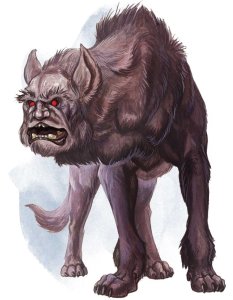
A yeth hound as seen in the fifth edition Dungeons & Dragons Volo’s Guide to Monsters. [Image courtesy Wizards of the Coast]
But if a creature is actually living somewhere, it has to eat.
It has to sleep.
It has to reproduce.
It has to protect itself.
It has to compete with other creatures.
It has to respond when the environment changes.
You don’t need to become a zoologist every time you introduce a goblin, owlbear, or dragon. You just need to think about the creature as something that occupies a place in the ecosystem.
An owlbear isn’t interesting because it has a certain number of hit points.
An owlbear is interesting when the party realizes that the “owlbear problem” isn’t actually an owlbear problem.
Something has driven the creature out of its normal territory.
Maybe logging has destroyed its nesting grounds. Maybe another predator has moved into the region. Maybe someone has been stealing its eggs. Maybe its usual food source has disappeared.
The villagers might want the owlbear killed because it’s attacking livestock.
The party might discover that killing the owlbear simply leaves an ecological hole that something much worse will fill.
Now the players have a decision to make.
That’s much more memorable than “roll initiative.”
The Monster Doesn’t Have to Be Evil
This may be one of the most useful lessons Dungeon Masters can steal from The Witcher.
A monster can be dangerous without being evil.
Those are not the same thing.
A mother monster protecting its young can be terrifying. A territorial creature can kill people who wander too close to its nest. A predator can hunt livestock because that’s what predators do.
None of those motivations require an alignment of Evil.
D&D has a long tradition of creatures that are essentially walking embodiments of evil, and those monsters certainly have their place. Sometimes your players need to fight something they can feel good about killing.
But if every monster is evil, the players eventually stop asking questions.
They know what the answer is before the investigation begins.
The Witcher gives us a different model. The monster hunt can become an investigation because the players don’t necessarily know whether the creature is the problem, a symptom of the problem, or simply another victim of it.
That creates uncertainty.
And uncertainty makes encounters interesting.
Give the Monster Consequences

A gibbering mouther as seen in the fifth edition Dungeons & Dragons Monster Manual. [Image courtesy Wizards of the Coast]
This is another place where Dungeon Masters can get a lot of mileage from monster design.
What happens if the party kills it?
Maybe the villagers celebrate.
Maybe they don’t.
Maybe the creature was keeping something else away.
Maybe its death releases something from its lair.
Maybe the local ecosystem changes.
Maybe the monster’s offspring are now orphaned.
Maybe the party discovers that the creature was protecting a person who had been hiding from an even greater threat.
Maybe the creature was the only thing preventing undead from leaving an ancient burial ground.
The important thing isn’t that every monster needs a complicated twist.
The important thing is that the world should react to what the characters do.
This connects directly to one of the recurring lessons in this series. In Breaking Bad, actions create consequences. In Jurassic Park, removing one problem changes the behavior of everything else in the ecosystem. In The Descent, the environment itself becomes part of the adventure.
The Witcher applies the same philosophy to monsters.
Kill something and something changes.
Spare something and something changes.
Ignore something and something changes.
That’s how a campaign begins to feel like a world instead of a series of encounters.
Let the Players Investigate Before They Fight
One of the most useful ways to bring this into D&D is to stop introducing monsters by showing the monster.
Instead, show the evidence.
Something is killing sheep.
There are strange tracks in the mud.
A hunter disappeared three nights ago.
A child insists that something is watching their house.
Someone keeps finding dead birds arranged in a circle.
The local priest claims it is a demon.
The old woman who lives at the edge of the woods insists it’s not.
Now your players have questions.
What happened?
What kind of creature could do this?
Where does it live?
Why is it attacking?
Is the person who hired us telling the truth?
Those questions turn a monster encounter into an adventure.
The players can investigate tracks, interview witnesses, research old stories, examine corpses, follow rumors, and explore the environment.
By the time they finally encounter the creature, they already know something about it.
That makes the fight more meaningful.
The players aren’t fighting “a ghoul.”
They’re fighting the thing that has been dragging bodies out of the cemetery for the last three weeks.
Those are completely different experiences.
Give Monsters a Signature

You don’t need to completely reinvent every D&D monster.
In fact, you shouldn’t.
The existing monster manual is filled with fantastic creatures. The trick is giving those creatures something players remember.
A troll might leave strips of skin hanging from trees as territorial markers.
A vampire might collect the wedding rings of everyone it has killed.
A hag might never physically enter a settlement but communicate through children’s dreams.
A mimic might imitate objects that have sentimental value rather than treasure.
A gelatinous cube might have learned to follow the scent of blood.
A dragon might deliberately leave survivors because it has discovered that terrified witnesses spread its reputation farther than any herald could.
None of these changes require a new stat block.
They change how the monster exists in the world.
And suddenly your players start recognizing monsters by their behavior rather than their names.
“Something has been leaving those rings.”
“Oh no.”
They don’t need you to announce what they’re fighting.
They already know.
The Monster Can Tell a Story
One of my favorite ways to approach monster design is to ask what the creature says about the place where the adventure happens.
A monster should ideally tell us something.
A town plagued by undead tells us something about that town’s relationship with its dead.
A forest filled with mutated beasts tells us something about what is happening to the environment.
A dragon sitting on an enormous pile of weapons tells us something about the adventurers who have previously tried to defeat it.
A village terrified of a creature that has never actually attacked anyone tells us something about the villagers.
The monster becomes a piece of worldbuilding.
This is especially useful when you’re designing adventures from scratch.
Instead of deciding, “I need three encounters for this forest,” decide what has happened to the forest.
Then ask what creatures would naturally exist there because of those circumstances.
The encounters start generating themselves.
Make the Players Wonder If They’re Right

Tethered ones are one of the ghostly new monsters lurking in the temple beneath the Forgotten Oasis. [Art by Nelson Vieira]
They hear that something horrible lives in the swamp.
They investigate.
They find tracks.
They find victims.
They find a lair.
Everything points toward the monster.
Then they discover something that doesn’t fit.
Why are there human footprints beside the creature’s tracks?
Why hasn’t it entered the village even though the villagers claim it has been attacking them?
Why are all the victims carrying the same strange symbol?
Why does the monster flee when it sees a particular NPC?
You don’t need to build a murder mystery every time the party fights a monster.
But giving the players one unanswered question can transform the encounter.
Now they aren’t just trying to survive.
They’re trying to understand.
And understanding creates investment.
Don’t Be Afraid to Let the Players Choose
This is where The Witcher can inspire some particularly interesting D&D adventures.
The party discovers that the monster is dangerous.
That’s not in question.
But killing it isn’t necessarily the only solution.
Maybe they can drive it away.
Maybe they can relocate it.
Maybe they can break the curse responsible for creating it.
Maybe they can negotiate.
Maybe they discover that someone else is manipulating the creature.
Maybe they decide that the villagers are the actual threat.
The point isn’t that there must always be a peaceful solution.
Sometimes the monster really does need to die.
The point is that the players should occasionally have enough information to make that decision themselves.
And when they do kill the monster, the decision should matter.
That makes the victory feel earned.
The Best Monster Encounters Begin Before Initiative
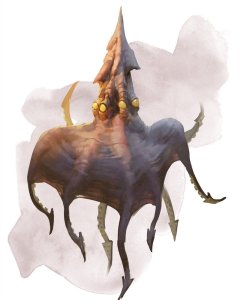
A darkmantle as seen in the fifth edition Dungeons & Dragons Monster Manual. Totally looks like a witch’s hat to me. [Image courtesy Wizards of the Coast]
A monster encounter doesn’t begin when the monster appears.
It begins when the players hear the first rumor.
It begins with the footprints.
The missing livestock.
The strange corpse.
The frightened villagers.
The old journal.
The warning scratched into a tree.
The abandoned campsite.
By the time the monster finally steps into the light, the players should already have a relationship with it.
They should know something about it.
They should have theories.
They should have questions.
Maybe they’re frightened of it.
Maybe they’re angry at it.
Maybe they feel sorry for it.
Maybe they don’t know what they think yet.
That’s the difference between fighting a monster and hunting a monster.
And hunting a monster is an adventure.
Make Your Monsters Matter
D&D gives Dungeon Masters hundreds of monsters with ready-made statistics, abilities, and lore. That’s incredibly useful, but the stat block is only the skeleton.
The story is what makes the creature memorable.
Give it a history.
Give it a territory.
Give it a reason to behave the way it does.
Give the players clues before they meet it.
Think about what happens when it dies.
Think about what happens if it survives.
Most importantly, make the monster part of the world.
Because the monsters your players remember years later probably won’t be the ones with the highest challenge ratings.
They’ll remember the creature that lived beneath the village.
The thing that everyone was afraid to enter the woods because of.
The monster whose tracks they followed for two sessions.
The creature they almost killed before discovering why it was there.
The monster they decided to spare.
Or perhaps the one they absolutely had to kill, and what happened afterward.
That’s what The Witcher understands about monsters.
A monster is much more interesting when it isn’t waiting for the heroes.
It was living its life before the adventurers ever arrived.
And once the adventurers leave, the world should continue to live with what they did.

No Comments